
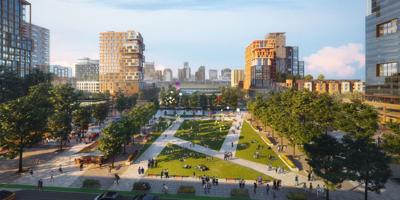
Imagine a Nashville in which the urban environment embraces the Cumberland River, prioritizes pedestrians, stitches together neighborhoods anchored by public art, and minimizes the scars—emotional and geographic—caused by paving interstate road through historic communities.
Twenty years ago, those principles inspired The Plan of Nashville: Avenues to a Great City, a 2005 book born of a two-year community-visioning process led by the Civic Design Center.
Now through Dec. 14, those principles adorn the walls of the Conte Community Arts Gallery at Frist Art Museum, where the free exhibit Avenues to a Great City explores the first 20 years of The Plan of Nashville’s 50-year vision.
In collaboration with the Civic Design Center, the Frist will host three events this year, examining past, present and future of The Plan of Nashville.
The first, retrospective event took place in July, on opening night of Avenues to a Great City. Civic Design Center chief executive officer Gary Gaston moderated a panel with The Plan author Christine Kreyling, who now lives in Northern California; architect Seab Tuck; and Joni Williams, who started her career at Metro Planning in 2005.
Their conversation ranged from memories of the Urban Design Forum—the precursor to the current Civic Design Center--to proposals for removing or capping sections of interstate to create greenspace, to development along the East Bank of the Cumberland.
“East Bank is the best example of a project that came out of The Plan ofNashville,” Gaston says, citing the project’s orientation to the river, its pedestrian focus and its transformation of parking lots and industrial land into mixed-use neighborhoods. He adds, “We use the principles of The Plan to guide our work and mission. We always go back and ask, ‘Is this project living up to The Plan?’ to decide whether we are going to support a project.”
On Aug. 21, the Frist hosts the second of three events— “A 50-Year Vision” —to examine current projects applying principles of The Plan. “Neuhoff is an amazing example,” Gaston says of the repurposed meatpacking facility turned LEED-certified mixed-use community in Germantown. “It’s well-designed, community-based, and engages with river and greenways.”
Finally, a December event will look at what’s next. “We’re looking toward the future,” Gaston says. “What do we need to do to re-energize and meet the goals of our 50-year vision?”
Register through Civic Design Center for “A 50-Year Vision,” Aug. 21, 6 p.m., at:
https://www.civicdesigncenter.org/all-events/pkn50-50-year-vision


Commented
Sorry, there are no recent results for popular commented articles.