
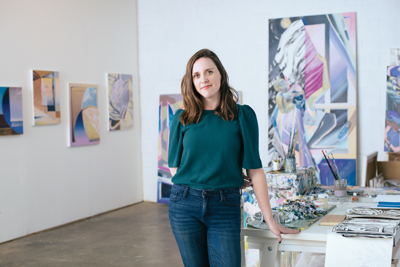
Karen Seapker is a bold artist, not only because the vibrant colors and graphic brushstrokes she works with demonstrate a confidence in her aesthetic decisions, although that is certainly true. Karen is bold because she constantly pushes herself — both in the subjects she chooses and the formal qualities with which she presents them — even after reaching a point of excellence.
“I seek to find a way to use my paintings to engage with material to create real meaning and ask real questions,” she says. Karen speaks with precision and a quiet demeanor that might not be what you'd expect from someone with such a visually striking body of work.
“Visually, the paintings are so poppy that I think they're easily understood at a surface level, but they're not just that. I lean on my paintings to pull myself out of daily life in some ways, but I also use them as possibilities. I take things from my life and consider what it means to be human in various stages of life.”
When Karen moved to Nashville from New York just over five years ago, she quickly became involved with the local art community and the independent artist collective Coop. At that point, her work was largely about memory; she painted landscapes from her childhood and portraits of family members overlapped with swirls of dizzying color, sort of like Van Gogh's “Starry Night.” Slowly, those swirls became central to her work, which have since become much more abstract.
A recent showcase of paintings at Zeitgeist, the Wedgewood-Houston gallery that represents her, was filled with large-scale canvases that focused on candy-colored Gerhard Richter-style streaks of paint. On closer examination, the paintings showed Egyptian goddesses nursing children or a Madonna figure holding her son. The turn toward ancient subject matter corresponded with Karen's own foray into motherhood — she and her husband, musician Bill Eberle, are raising their two daughters in Nashville. Still, Karen doesn't want her paintings to be understood as anything other than contemporary — she includes details like Nike sneakers and graphic T-shirts on her goddess subjects.
“I was at a point in my life where I really wanted to surround myself with powerful women,” she says. The series is called "Sentinels," and the works function like stained glass in a grand cathedral — when you're surrounded by them, you can't help but feel empowered. To Karen, painting is very much a romantic pursuit.
“They're not just paintings about painting,” she says. “I'm trying to nudge out what life is.”
The Basics
Name: Karen Seapker
Represented by: Zeitgeist Gallery
Education: MFA in painting from Hunter College in New York, Honors BA in studio art and art history from Muhlenberg College
See her work: Wilder showroom at Seventh and Taylor, Metro Nashville courthouse, private collections
Website: karenseapker.com
The Art
"Offering (For Renenutet)"
2017
Oil on canvas
72 x 60 inches
Renenutet is the Egyptian goddess of the harvest and nourishment, and she was frequently depicted with the head of a cobra. The extremely maternal combination of destructive and protective qualities occurs throughout ancient Egyptian mythology. Here, Renenutet is shown nursing a child on a royal purple panel. “I think about how I can utilize color to create rhythms,” says Karen. “If you put colors next to one another and they contrast enough, it can indicate a really quick jump. I think about it as a way of choreographing a visual experience.”
"Night Waking (For Durga)"
2017
Oil on canvas
48 x 36 inches
Durga is a many-armed protective mother goddess in Hindu mythology whose power centers around destroying evil and other threats to peace. She is often shown riding a lion or tiger and has many arms, each of which carries a weapon. In this painting, a figure cradles a child with a halo radiating around its head. But looking closer, it also seems as though both figures are themselves being held — the whirls of fingerprints are evident on the tendrils that surround them.
"Near and Dear"
2017
Oil on panel
16 x 12 inches
In this painting, there are different panels that are shifting back and forth in space, suggesting different but simultaneous rhythms. “Motherhood has slowed my body down so much,” Karen says, “but the contradiction in that is that it's also torn down a lot of walls and has been this empathic thread. Because of that shift in interior and exterior thought, I wanted [to make paintings that] collapse in space a little bit and to slightly suggest a space that might open up but might also be closing.”


Commented
Sorry, there are no recent results for popular commented articles.