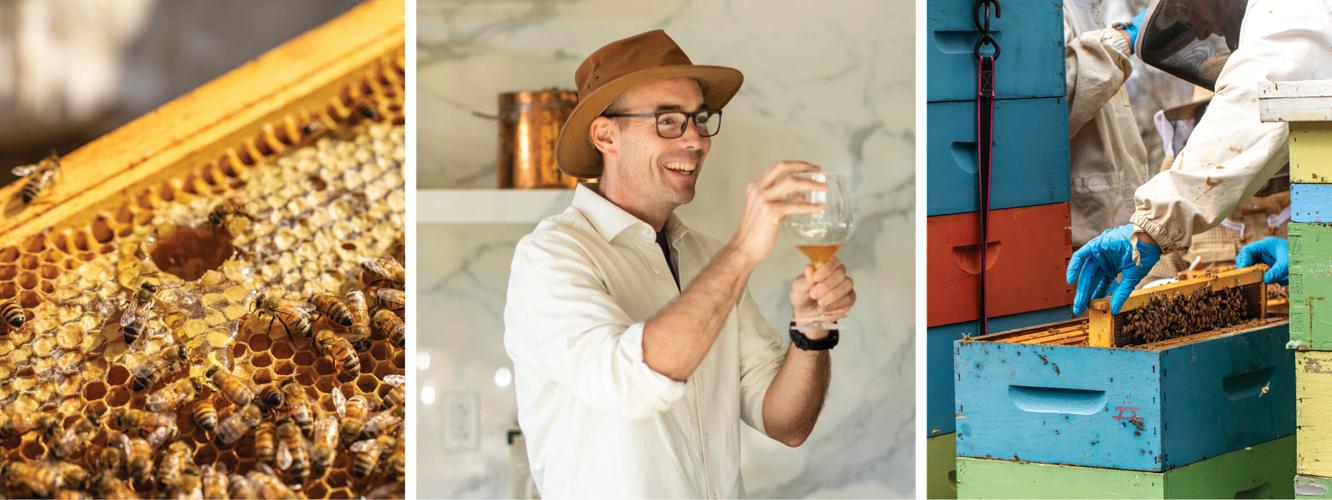
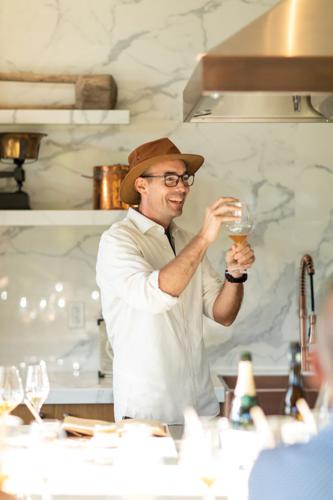
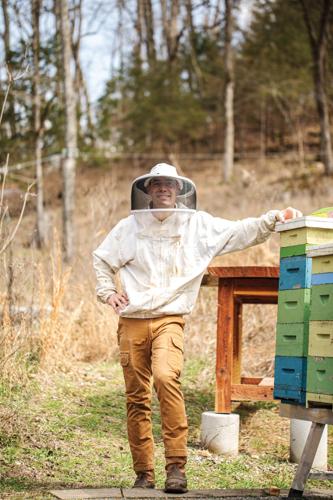
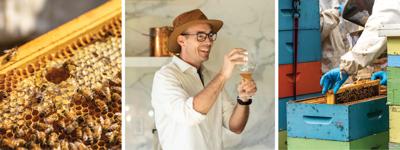
The 2023 honey harvest at Southall Farm & Inn tastes radically different from the 2024 batch, especially to the trained palate of level 2 honey sommelier Jay Williams. And if you can’t quite put your finger on the flavor variation between last year’s golden liquid and this year’s lighter-but-more-viscous syrup, then Jay, who launched the pollination program at Southall Farm & Inn, can explain it all in a way that will lead you, too, to marvel at the beauty and science of bees.
Here’s a hint: It has to do with nectar, which has to do with the blooming of trees, which has to do with the weather. Because everything in nature is connected. Likewise, everything in the bee program at Southall is intentional.
Jay Williams is a former firefighter from California who founded Williams Honey Farm in Franklin in 2008. He has been managing Southall’s bees since 2017, when former options trader Paul Mishkin and his wife Laura recruited him to oversee a pollination program at their sustainability-focused luxury seed-to-fork farm and resort. In 2025, when Jay passes the third level of honey sensory training in Bologna, Italy, he will join a small handful of honey sommeliers in the U.S. certified on the Italian national registry.

Standing on a sunny hillside between the apple orchard and the stone-and-timber inn, Jay gestures toward the Thomas-Jefferson-style irrigation system to show how water from production fields drains underground to Lake Mishkin, at the center of the 425-acre working farm, and then gets pumped uphill to water 40 breeds of apple trees before it drains back to the kitchen gardens. Then he points to the far border of the lake, beyond a paddleboarding visitor, and explains that, at this minute, there are as many as 7 million honeybees above the treeline.
“That’s the party zone,” Jay says, referring to the mating habits of Southall’s drones (male bees). He knows, because he mapped the airspace with a drone (remote-control quadcopter) to trace flight patterns of native insects before he set up a network of eight apiaries to breed a unique line of queens drawing on the genetics of Slovenian Carniolan bees.
“Bees are incredible,” Jay says simply, before launching into a complex explication of the ecosystem he stewards. The same could be said of a beekeeper who uses Bluetooth technology to monitor hives, as Jay does, checking his phone to make sure temperatures are always between 93 and 95 degrees. (Yes, they are, even though it’s a 70-degree day, because bees can self-regulate their temperatures. On a 100-degree day, Jay explains, they all turn one way inside the hive and buzz to make a giant fan. Incredible.)

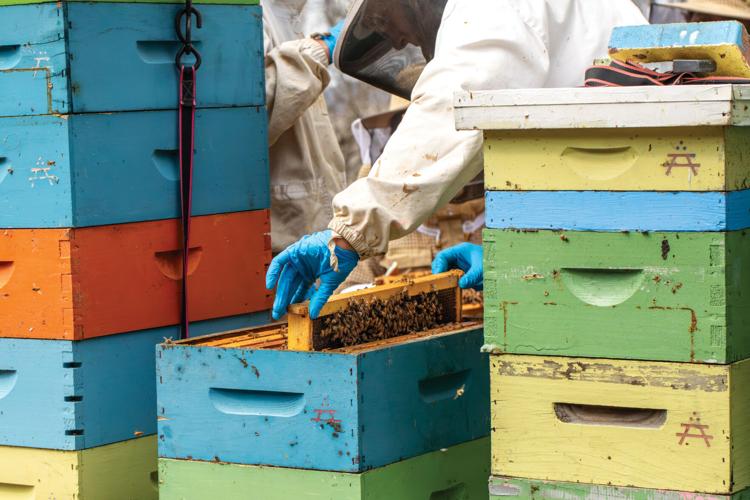
Southall overnight guests can take a “bee cruise” of the apiaries, which look like oversized colorful LEGO towers around the property. Winding up the hill by the terraced orchard of apple trees, you’ll see tiny blue wooden boxes that house pollinator bees, which are different from honeybees. You’ll see the home of the late “Queen Nona,” the first queen Jay raised on the property. Stops along the way might include Dottie’s Speakeasy, a quiet cocktail lounge whose elegant clubby interior design draws on the life story of Jay’s grandmother. And you might borrow a beekeeper’s suit from the laboratory-kitchen where Jay and assistant pollination program manager Katherine Hagan artificially inseminate queens, fabricate hive equipment, process beeswax, rotate Southall honey in local whiskey barrels, and steep cayenne peppers to create hot honey.
At some point in the journey, as the panorama unfolds to look like an Impressionist landscape gaudy with blue sky and white clouds, you might feel like you’ve been transported to Italy. Maybe it’s the view, or maybe it’s because Jay is talking about his Italian training as a honey sommelier and about the Italian bees he raised before selecting the Slovenian-heritage strain that now populates Southall’s 140 colorful hives.
Southall opened its 62-room inn and 16 guest cottages to the public in December 2022. In 2023, the bee program harvested approximately 2,000 pounds of honey and 50 pounds of raw pollen, and it’s on track to collect even more this year. That honey makes its way onto menus at the property’s Sojourner and January restaurants, onto shelves of the farmstand on Carters Creek Pike and into the Jammery, which hosts honey tastings once a month. Someday, if Jay gets his wish, the bees will make their way into the walls and floors of a specially constructed guest cottage so visitors can sleep inside a traditional Slovenian-style cebelnjak, or bee house. “Either you’ll love it, or you’ll run for the hills,” he says.
Williams may have boundless knowledge of the science of bees, but he’s trying to impart something more than entomology. He’s trying to draw a connection between humans and nature writ large in the stewardship of hives and honey. “It’s the best therapy you could ever have,” Jay says. “Because it can’t be rushed. You have to control your breathing and always be looking around you.”

Always be looking — that is, unless you’re participating in a “Trust Me Honey” tasting, in which Jay and Jammery chef Richard Jones introduce blindfolded guests to a flight of various raw honeys, to explore connections between taste, smell and memory.
That’s when you might learn why Southall’s honey harvests of 2023 and 2024 yielded such different crops. Jay explains that, due to cold, wet weather in 2023, the black locust bloom was a bust. But the Catalpa trees filled in for the nectar flow. The result was a zing of green apple and a sweet spice at the back of the throat. In 2024, things were back to normal — the honey has a buttery taste with warm notes of jasmine and citrus.
“Honey tells a story like fine wine. Pour it with the right things and it will come alive,” Jay says. “We’re not trying to make everyone be a beekeeper. We just want people to recognize these things and how special they are. If we can do that, we think we’ve done enough.”


Commented
Sorry, there are no recent results for popular commented articles.