

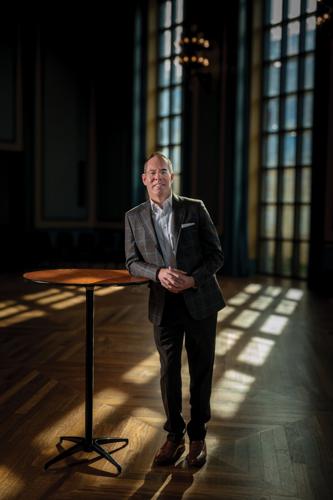


When it comes to events, Amos Gott and Vincent Dreffs have seen trends come and go — and waste pile up along the way. Amos, founder of Amos Events, is one of Nashville’s most sought-after social event planners. And Vincent, whose company Dreffs for Success has produced everything from the 2002 Winter Olympic Games to the 145th Kentucky Derby to the NBA All-Star Game, operates at a global corporate scale. Both have decades of experience — and both have seen sustainability become a bigger focus in modern-day event planning.
Sustainability still isn’t a priority at every party. “Weddings and social events want what they want,” Amos is quick to note. But what used to be a niche trend is becoming mainstream — particularly when cost is involved. Still, there’s room for improvement: Sometimes hosts with the best of intentions are stifled because of the expense of recycling and other sustainable practices.

Waste-Heavy
Events are inherently waste-heavy. In 2008, the average wedding produced about 400 pounds of waste, according to The Green Bride Guide author Kate L. Harrison. Today’s estimates are even higher. Waste-management planning guides suggest that weddings generate about eight to 12 pounds of trash per guest, and buffets (which are becoming increasingly popular) create even more. Multiply that by 100 guests, and it’s not hard to imagine the trash piling up.
For context, the average American produces 4.9 pounds of waste — about half that amount — per day, according to Environmental Protection Agency estimates.
Food is the largest contributor to trash at most events, both social and corporate. Venues and caterers can’t recycle food once it’s been out for a certain amount of time — or even once it’s left the kitchen. So in an effort to mitigate waste, many planners have become more conservative when ordering catering.
Many corporate event planners, for instance, adjust down breakfast numbers, anticipating that convention attendees may eat on their own or skip breakfast altogether.
This is common practice with any event, Vincent notes. “Most planners tenured with a program rely on historical actual attendance numbers, as a percentage, for current guarantees to the food service provider,” he says.

Niche in Nashville
For years, factoring sustainability into event planning was a niche idea — often thought of as “greenwashing” (deceptively making something seem eco-friendly when it isn’t). Even today, there’s less focus on designing sustainable events in Nashville than there is on the East and West coasts.
In many coastal cities, local governments have tied event permitting to waste diversion regulations, requiring hosts to handle recycling and composting, choose reusable cups and dishes, or donate leftover food to local organizations. Some cities, like New York and San Francisco, publish sustainability guidelines that encourage event planners to track waste diversion efforts and carbon emissions.
But often, resistance doesn’t stem from lavishness or carelessness. Instead, it’s the expense of sustainable practices that stalls hosts’ best efforts.
“Many [local] venues make the effort to be green, but it can be logistically difficult,” Amos shares. Vendors and venues have to work together, even when their sustainability practices are at odds. “It is a fragile ecosystem that [relies on] everyone working together,” he says. “And even still, the expense is often prohibitive.”
While some events donate centerpieces to local organizations, someone still has to pick them up and distribute them — and there are often fees involved.
“Sustainability requirements have not really hit Nashville like the coastal cities,” Vincent notes. But he sees this as an opportunity. “There is room for someone to put together a sustainability package that pulls together all of the elements, including waste reduction, composting, recycling and removal,” he says.
Sustainability in Practice
Even without formal requirements, some local planners and institutions are already modeling what sustainability can look like.
For one thing, Nashville’s event rental market is more sustainable than it’s ever been, Amos says. Silver, linens and crystal are all reusable, and rental companies have access to more unique items, meaning hosts don’t need to purchase single-use décor.
Many large social events are also finding ways to repurpose decor and minimize waste. The Heritage Ball donates its floral arrangements the day after the gala. For years, the Swan Ball has sold its décor at the Swan Sale, giving items a new home and raising more money for its beneficiary. Recently, the Cheekwood Society even sent event invitations on seeded paper for guests to plant at their homes.
Vincent has seen sustainable practices on a larger scale. When one corporate group held its annual meeting in a small city, it worked with local leaders to purchase 250 energy-efficient water heaters for affordable housing units, reducing the event’s strain on the energy grid and the business’s carbon footprint. When working on the Olympics, Vincent and his team pre-sold all of the concession equipment, ensuring it had a home once the event was done.
For event planners like Amos and Vincent, sustainability isn’t about perfection or performance — it’s about intention. They walk a tightrope, executing client vision, considering local stakeholders and living up to a high level of excellence.
As expectations evolve and conversations around waste become more common, the most successful events may not be the ones that tout being “green,” but the ones that quietly make better decisions at every step. Clients can choose rentals over single-use items, donations over discards, and collaboration over convenience. In that environment, sustainability is no longer a trend to chase — but a path forward.



Commented
Sorry, there are no recent results for popular commented articles.