

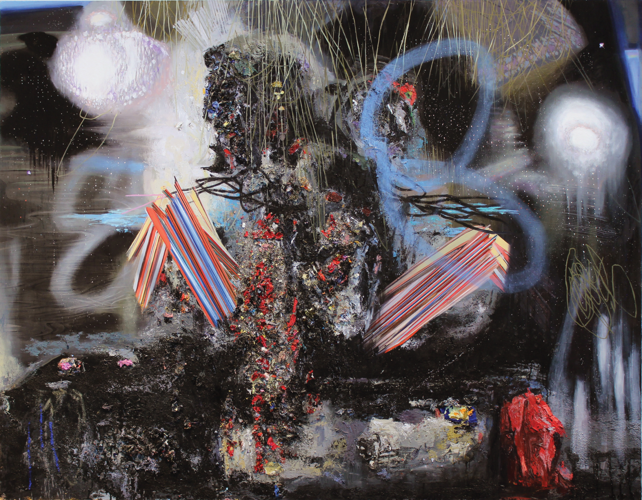

The amount of time James Perrin spends working on his paintings tends to make itself known through small autobiographical details, as if the paintings are absorbing bits of his personality simply because of the time they've spent together. The title of his painting “The Time Before the New” refers to the year it was painted, which was the year before James married, had a son and saw his life forever altered. Small, luminous orbs of pale paint are a recurring image on his canvases, and they represent a body's white blood cells, the constant protagonist in his family business, Perrin Naturals, which produces natural skin care products.
“I like to put things in the paintings that I pull from my life,” James says. “And because the paintings are very abstract, I like for the abstractions to have meaning. That keeps me anchored in the painting and interested in it.”
He spends months on each painting, borrowing imagery from sources as diverse as fashion photography, Baroque-era paintings and photographs he's taken at Walmart. He likes working with this cache of visual references, and he manipulates them digitally until they're unrecognizable, even after he's revealed their origins.
“Even if you don't recognize it, the intentionality causes people to believe in the work, regardless of their connection to it,” he says.
But his paintings are much more than simply exercises in composition. James, who received the prestigious Joan Mitchell award in 2015, asks big questions with his art.
“I'm drawn to these questions on a subconscious level,” he says. “What is conflict and what is resolution? What is beauty? What is chaos? With my paintings, I try to reflect on what life is — life is beauty in the midst of ugliness.”
The canvases must have chaotic swirls of color, James explains, so that the sublime white or black paint becomes amplified. He compares his painterly choices to navigating the weather — if all the days are filled with sunshine, you can begin to take it for granted.
“We're able to appreciate good weather only because we know what bad weather is,” he says. “Sometimes even mistakes can turn into opportunities, or something that is chaotic can be resolved into something orderly. You don't know what goodness is, or pleasure is, until you experience the opposite. So our scope of understanding is limited until we experience the other end of it.
“I try to embody all of human experience — whether emotionally or spiritually — and try to put it into an image that reflects our life.”
The Basics
Name: James Perrin
Represented by: Tinney Contemporary
Education: MA from Boston University, MFA in painting from American University, BFA from Kansas City Art Institute
See his work: Dream Nashville, Pinnacle Bank, Creative Artists Agency
Website: jamesperrinstudio.com
The Art

“The Time Before the New”
2016
79 x 96 inches
Oil on linen with acrylic resin and paint scrapings
For an artist as dedicated to abstract painting as James, “The Time Before the New” seems almost figurative. James has based the work's central shape on formal elements borrowed from the Hindu god Vishnu — this figure, like Vishnu, has multiple arms reaching in multiple directions. James also draws elements from Spanish Golden Age master Diego Velázquez, particularly his series of royal portraits of Princess Margarita Theresa. The stripes in James' painting are direct references to a gown the princess wore in Velasquez's 1659 portrait.

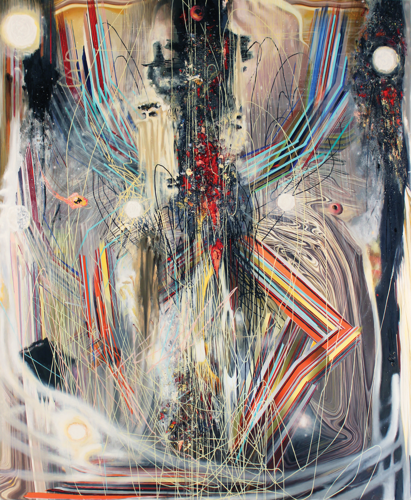
“Semiosis on the Sea”
2016
50 x 64 inches
Oil on linen with acrylic resin, plant resin, paint scrapings and Tahitian pearls
This painting has been exhibited at the Frist Art Museum, where it shared space with art-world heavyweights like Ellen Gallagher, Franz Ackermann and Wangechi Mutu as part of the 2018 contemporary painting exhibitChaos and Awe. It takes its form from a woman sitting beneath an umbrella on the beach, her legs bent at the knee. James downplays a conceptual analysis of the work, remaining more interested in compositional elements like the broad violet marks that almost look like wings. “That’s simply a gestural mark that sits on the surface of the painting,” he says.

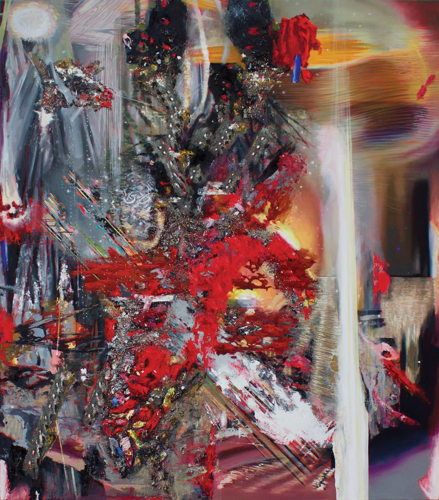
“A Second Measure of Time”
2017
72 x 64 inches
Oil on linen with acrylic resin, plant resin and paint scrapings
The wash of red in this painting — named after a similar work called “A Measure of Time,” which sold before James had the chance to exhibit it — is an example of his treatment of paint scrapings as a compositional element. “I'm interested in paint as an object,” he says. "The paint scrapings are objects in and of themselves, and they're also descriptors of space and color.” The swirling brushstrokes in the background allude to a spiritual, almost galactic dynamic for the red scrapings to play against.


Commented
Sorry, there are no recent results for popular commented articles.