
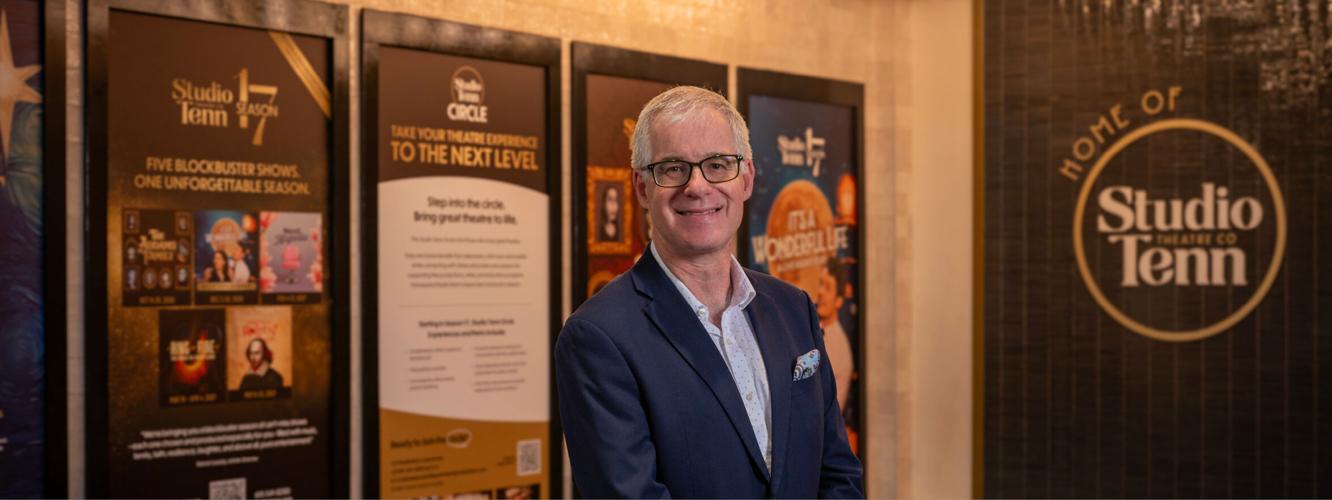
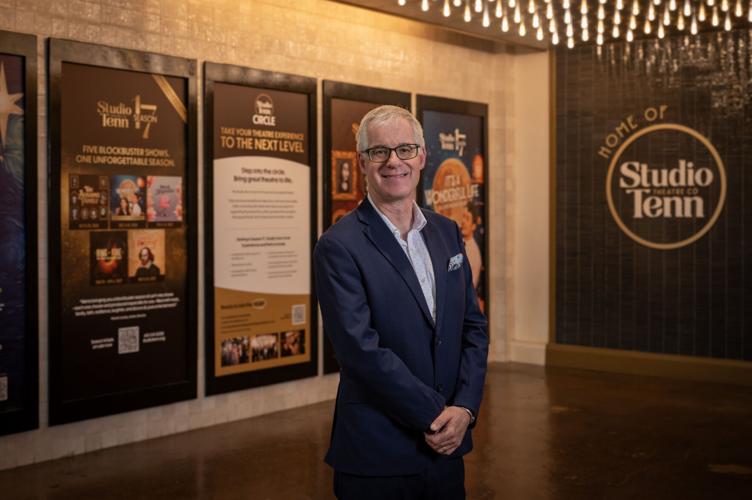
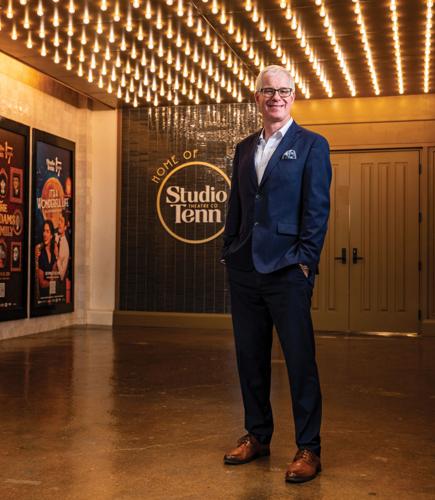
Mark Fleischer’s arrival in Franklin doesn’t just signify a personal fresh start — it’s ushered in a new era of growth for Studio Tenn. As the organization’s newly minted executive director, he’s concluding 12 years of leadership at Pittsburgh Civic Light Opera to support Studio Tenn’s growing ambitions with sturdy organizational infrastructure.
Countless productions have impacted the lifelong theater-goer, from Sunday in the Park with George to A Chorus Line to August: Osage County. Mark channels this love of the performing arts into holistic leadership, pairing creative expression with sustainable development.
Collaborating closely with artistic director Patrick Cassidy, Mark seeks to bring a balanced approach to Studio Tenn’s strategic planning, financial stewardship and community engagement. Nfocus met him at Studio Tenn’s Turner Theater in the Factory at Franklin to discuss the company’s 2026-27 season, audience engagement and how good art creates conversations.
Studio Tenn introduced the executive director role with your arrival. How will this level of leadership usher in a new phase for the company?
The role was created with the idea of leveling up. We just launched a program called the Studio Tenn Circle, which is a sustained giving program with different levels. I’m really looking at the best of the places I’ve worked and the people I know, and bringing that to the organization. It’s grown so fast based on Patrick’s vision and the theater’s artistic quality. My goal is to give the scaffolding and understructure that will continue to support that growth.
I come from an organization that has a huge education program. I’m asking, “What is already done in the community? What is the niche that’s not being served, and how can we serve that?”
How do you plan to deepen the connection between audience members and onstage productions?
Producing a show is like picking up a rock and throwing it in a lake. The rock is the production. Hitting the splash is the performance, and it’s going to make ripples. Sometimes it’s a big ripple, and sometimes it’s small ripples. But the thing that’s come to me over my 30-plus years in the business is you also have to know the lake you’re throwing it into. I’m kind of learning the lake, as it were.
The thing we’re actually doing is starting a conversation, and good shows are worth talking about, whether that’s the ideas or the performance. There are studies that say, as we watch a show, our heart rates sync. Our breathing goes in sync.
Even just watching Jesus Christ Superstar and seeing the response to that — people loved it. I launched a new series for Studio Tenn called Beyond the Stage, where I brought in a rabbi and a pastor to come after the show and talk about the ideas. We had a mix of Jewish and Protestant and Christian audiences, and we had these great conversations. I’m hoping to do that for every show next year. What we can be, and what we are, is a gathering point.
How do you hope the company’s community engagement programs will grow?
I’m interested in exploring hands-on opportunities for both adults and young people, whether that’s a drop-in tap class or a drop-in learn-to-scene-paint. We do summer camps for kids. I’m not really going to add something just to add it. I want to see what is already in the community. What can we do to make this feel like the place you belong? And where can we find human connection, not just with the lights turned out, but from the person next to us?
What excites you most about the 2026-27 season, which kicks off in October?
Patrick’s put together what he keeps referring to as the blockbuster season. Something Rotten is written by Wayne Kirkpatrick. He’s from the area. He lives here, and I don’t think a lot of people know that. And we just had Adam Pascal playing Jesus. Adam was Shakespeare on Broadway and on the road, so there are connections to that.
There’s always some sort of Southern slot. Who are we? Who is this town as a culture? Whether it’s Steel Magnolias or Driving Miss Daisy, where can that go for us as a community? Where could we maybe commission our own plays about what it means to live in the South in this era, versus always looking back?
For this year, it’s about watching audiences respond. I’m being present in the lobby and hearing what people have to say. It’s a transition time for me. My wife and I will move down officially at the end of the summer. The number one question is, “Why Franklin? Why would you leave a $10 million theater company?” And I think there are new opportunities to build a company that is growing out of its community.
Quotes have been edited and condensed for clarity.


Commented
Sorry, there are no recent results for popular commented articles.