
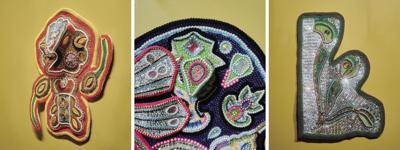

Hailing from New Orleans, the DuVernay Collective announced a partnership with Clarence Edwards, Nashville-based gallerist and event curator of cëcret by cë gallery, and Karen Wong, former deputy director of NYC’s New Museum, to launch DuVernay’s debut Nashville exhibition: Beauty and Pain. For this Nashville display, DuVernay Collective deconstructed their feathered suit, Beauty and Pain — initially worn as a ceremonial garment in the Mardi Gras parade — and upcycled the intricately beaded patches into embroidered emblems that bare stories of grief, hope and regeneration.
“cëcret by cë gallery was built to spotlight a diverse collection of artists, both in Nashville and around the country. I am thrilled to welcome DuVernay Collective into the Merritt Mansion — a space that shares a reverence for history and commitment to reinvention,” says Clarence Edward, curator and founder cëcret by cë gallery.
Beauty and Pain will transform Wedgewood-Houston’s historic Merritt Mansion, currently home to cëcret by cë gallery, beginning on Thursday, September 7th. The exhibit will culminate on Sat., Sept. 30th with an afternoon artist talk between Charles DuVernay and Clarence Edwards, followed by an evening party fêting the artists.
As a member of New Orleans’s downtown tribe Monogram Hunters, Charles DuVernay began sewing as a child. On the occasion of Mardi Gras, he assembles an annual suit with the help of friends and family, individually sewing each bead and sequin, a process that takes over 900 hours. His artistic practice consists of sewing suits as part of the Black Masking Indian culture and upcycling the suit’s beaded patchwork into exquisite tapestries that amplify personal stories of beauty and pain. The work in this exhibition is dedicated to two individuals who passed away recently: DuVernay’s son, who lived for four days, and the unexpected death of his 38-year-old cousin, Big Chief Keelian Boyd. This artistic practice is one of immense dedication, secret sewing techniques passed on from generation to generation, and a testament to how legacy endures.
“Most [makers] spend thousands of hours on suit-making, only to wear them once, maybe twice, never to be seen again,” says Charles DuVernay. “We desire to extend the artistic practice by giving our work a second life and [making] this heritage contemporary.”
The tradition of Mardi Gras Indian suit-making was born in response to the French colonial rule of Louisiana. Many black individuals who escaped their indentured servitude found refuge in indigenous communities, where they covertly traded goods, shared information, and eventually intermarried, hence the name “Black Masking Indian.” Half a century after the first New Orleans Mardi Gras parade took place in 1837, approximately fifty Plains Indians in native attire marched unannounced in the 1885 procession. It was an act of celebration and defiance. In subsequent years tribes consisting of both Native Americans and Africans began to form, and they later competed over whose big chief donned the grandest suit. Today, the Mardis Gras tribes are composed of two camps: the Uptown Indians, distinguished by their flat beaded works and depictions of Indigenous culture; and the Downtown Indians, who focus on abstraction and 3D construction.
Encouraged by how several Uptown Indians were exploring other channels to reconstitute their work, Charles DuVernay was inspired to take his grand suits, disassemble them and connect the patches into tapestries that tell stories about his community, introducing them to the world through exhibits like Beauty and Pain.


Commented
Sorry, there are no recent results for popular commented articles.