


What would you risk to protect a neighbor or friend?
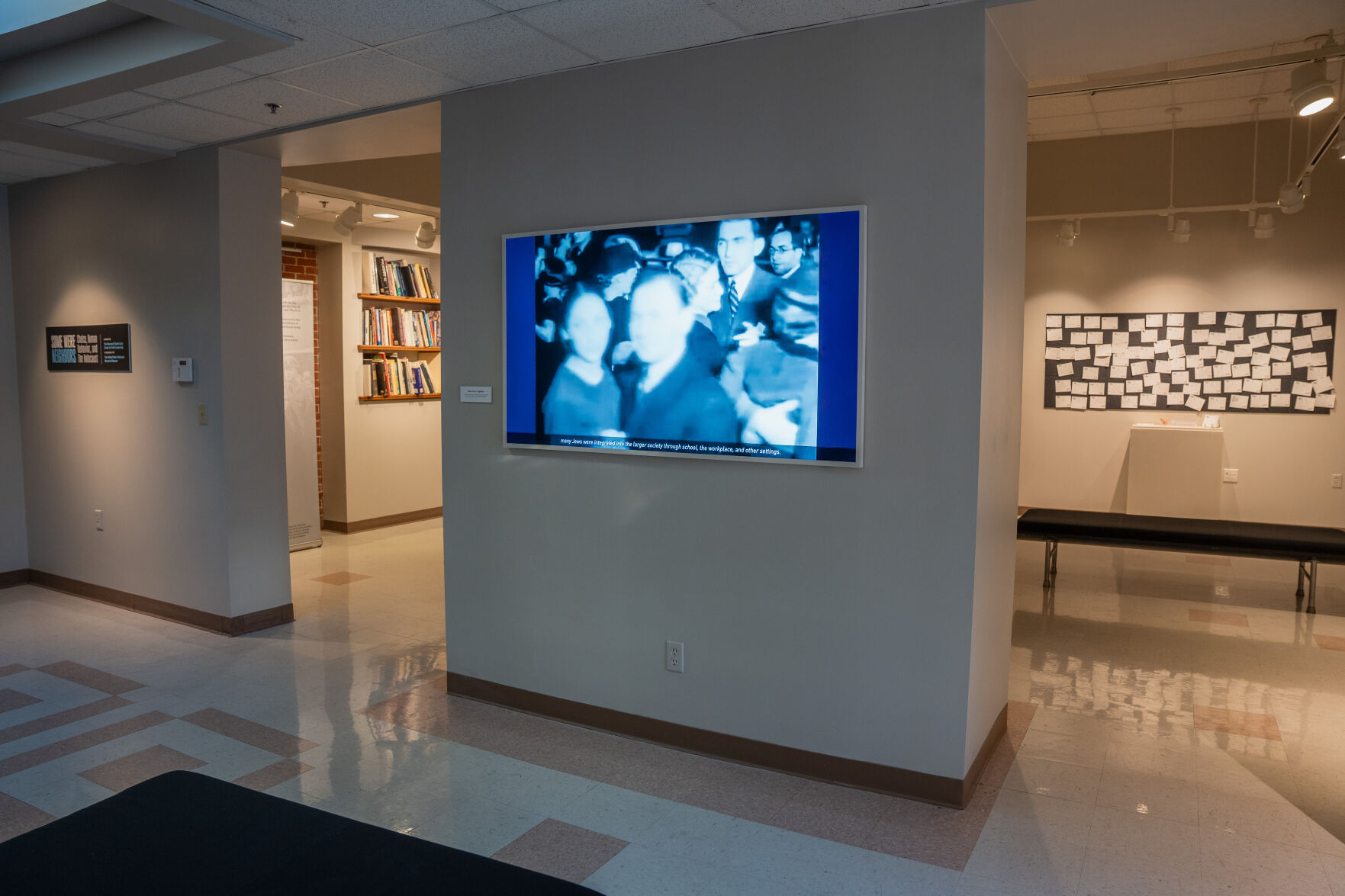
That heartbreaking question anchors the exhibit Some Were Neighbors: Choice, Human Behavior, and The Holocaust, at Belmont University’s Leu Gallery through Dec. 8.
A set of 21 large posters, provided by the United States Holocaust Memorial Museum, explores the roles community members played during the rise of fascism in Europe, with a specific lens on responses to the persecution of Jewish classmates, coworkers, neighbors and friends.
Among the featured stories, which span 1938 through World War II, a German police officer protects a young Jewish boy from a mob; a nanny helps young girls escape and survive when their parents are detained and killed; and Danes smuggle more than 90 percent of Denmark’s Jews into safety in Sweden.
The exhibit’s stories of courage and compassion are balanced by dark examples of complicity, reminders that the Holocaust was a compilation of a community’s action and inaction.
One poster captures the words of survivor Ester Bem, whose family hid in safety with strangers:
“I feel such gratitude to the people that saved us. And these…were ordinary people that will never be in history books…. In the era when goodness was very rare, they cultivated it…. They didn’t think of themselves…. This is something that I want the post-Holocaust generation to know, that people have choices….”

At the exhibit’s opening in September, United States Holocaust Memorial Museum volunteer Peter Feigl shared with Belmont students the story of his own remarkable survival, made possible by strangers who hid him in France when he was a child. The young audience was spellbound.
Belmont is the first university in the nation to host the traveling show, and the exhibition marks the latest collaboration between the Holocaust Memorial Museum and Belmont’s Office of Jewish Dialogue and Discovery. Housed at Belmont’s Rev. Charlie Curb Center for Faith Leadership, the office is jointly led by Dr. Jon Roebuck and Rabbi Mark Schiftan, who coordinate regular trips to the Holocaust Memorial Museum in Washington, D.C., in an effort to expand interfaith understanding and connections.
In conjunction with Some Were Neighbors, Belmont will screen a Holocaust-related film on Nov. 9.
Some Were Neighbors is free and open to the public during regular library hours.


Commented
Sorry, there are no recent results for popular commented articles.