
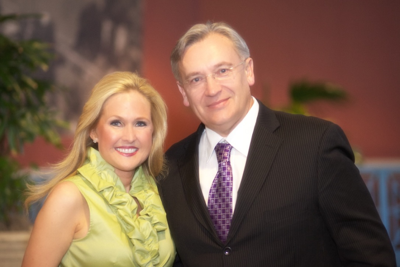
Deneen Turner, a nonprofit entrepreneur and resident of Franklin for over 30 years, has devoted her professional life to aiding the orphan crisis in Eastern Europe. A professional singer who toured with the late Billy Graham, Deneen learned of Human Rights Watch's tragic statistics regarding orphans in Ukraine: Within three years upon their release from the orphanages, 70 percent are homeless and living on the street, 20 percent are in prison, and 10 percent have committed suicide. “There's your 100 percent no hope future,” Deneen said.
After discovering that a two-story house in Eastern Europe costs less than American cars and jewelry, Deneen realized she had an opportunity. She partnered with Ukrainian national Yuri Yakovlyev to found HopeHouse International, a nonprofit that provides adequate housing for qualified families so they can adopt children in their own country. Due to a group of donors that covers all administrative expenses throughout the year, HopeHouse International operates with a financial model that allows 100 percent of donations to go directly to its mission.
Deneen sat down with Nfocus to discuss her organization's efforts to facilitate adoptions and give children hope.
Providing adequate housing in Eastern Europe sounds like a complicated process. Walk me through exactly how this helps orphans.
It overcomes a barrier for adoption. In Eastern Europe, the housing is still like communist housing — so big apartment complexes, 500 square feet or less. And because it's a multigenerational culture, six to nine people can often live in one house. … The problem is that many Christian families do want to adopt, but because they don't have the adequate living space, they will not pass the home study. … So what HopeHouse does is we tackle that one barrier … by providing housing for them. We do that either through purchasing and renovating homes, purchasing existing homes that are fine or building homes within our budget.
Does HopeHouse stay involved with families after the adoption process?
Yes, particularly through a program that we created in 2015 called Soul-Care, a counseling program that supports our parents by training [them] to help their children … address the past trauma that they've experienced in the orphanage … abuse, neglect, you name it. … Our parents need support and help in understanding what the kids have come from, what they believe about themselves, why they have such low self-esteem, how to help them better attach. … We have on-staff counselors, two in Ukraine, one in Romania, that work with all of our families.
Your co-founder and partner, Yuri Yakovlyev, was born under Communist rule in the Soviet Union and still operates in that region. How did you two meet?
We met when I was invited to come sing, … and [he was] one of the people that was in charge of helping us with the logistics. He was intrigued by the teams that I brought over, by the Christians he met, and about three years later he too became a Christian and wanted to dedicate his life to serving.
While you raise money here in the United States, what does Yuri do halfway around the world?
He is procuring homes and facilitating adoptions, identifying and interviewing candidates, simultaneously in different cities, different countries, with multiple families. We want to make sure that potential candidates are not speaking up for the wrong reasons because they want a house. We don't advertise, and honestly if somebody calls us, it's not usually an interview that continues to pass the stringent process. Usually, what happens is Yuri identifies potential candidates through orphanage directors and pastors in the country by simply asking them, "Who from your church?” or, “Who has been coming to serve the kids in your orphanage?" … And that helps us to make sure that we're hedging against any kind of wrong motive.
What gave you the idea for HopeHouse 19 years ago?
Eleven years prior to [founding HopeHouse], I was invited to sing in Ukraine, still during Communism. … We wanted to do something during the day with our time, so [we] decided, "Let's work in the orphanage." … So we began, 30 years ago, working in the orphanages providing ministry, drama, humanitarian relief items — just spending the day loving on the children. … And then one day, my husband [Mark] and I felt called to adopt. When we personally adopted, … I just felt called to do more.
Since you met Yuri and started HopeHouse, how has the situation in Eastern Europe changed for orphans?
For awhile, after their independence, it did start to get better. However, during the [Russian] invasion time, which started in 2014, it was a terrible situation in the orphanages there because my understanding is that soldiers were occupying the orphanages for places to live. Also, many men have been killed in this war, so there have become more orphans because women could not take care of the children.
So definitely, the need is as dire now as it has ever been.
Yes. It was getting better, and now it's gotten worse again. Dilapidated buildings, watered-down soup for food because there's just not enough money. So it's not healthy. They share toothbrushes. … They share clothes. … And often the workers aren't being paid for months at a time, so they're angry. So you have a bunch of angry workers working with children, and that's a recipe for a bad mix.
In the midst of all that, how specifically have you seen HopeHouse impact this crisis?
Since our formation in the end of 1999, we've been able to eradicate the equivalency of about 15 orphanages — probably looking at about 700 children that have been adopted. … What encourages me is looking at the exponential effect. So now, our HopeHouse kids that were adopted 19 years ago are grown and married, and they're having children. So the whole course of their life, their future, has changed. We're on our second generation of children who are affected because that one HopeHouse child was rescued and given a family. And inside that family, they were able to deal with their trauma and become whole emotionally. … Many of our HopeHouse kids now have gone to college. Many are in ministry. So when you think about those that are … working in their communities … again, that exponential effect is far beyond what I think we even know.
HopeHouse has held events all over the United States in cities like Atlanta, Dallas and Seattle, but what made you decide to make the Nashville-Franklin area home base?
[In] Nashville, Franklin, this area, people have a wonderful appreciation for the work of nonprofits. … People love to get in the field for nonprofits. So there's a real support here, a real understanding — a very quick understanding of what many of our organizations do … and that's a great support to all of us.
Finally, what can Nashvillians do to get involved with HopeHouse and help orphans in Eastern Europe?
We all appreciate all kinds of involvement. If people would like to learn more about our nonprofit, I'd invite them to visit our website. … But I'd like to say something even more important than that. There are many nonprofits in Nashville that are helping kids get parents on many levels. … So I guess I'd like to answer the broader question and just encourage people that if a nonprofit touches your life in a way that draws you in, I promise engaging in that — knowing that you're helping a child who otherwise has very little hope of love in their life — will be as rewarding as anything you'll ever do.
Photograph by Chris Mastalia Photography


Commented
Sorry, there are no recent results for popular commented articles.