
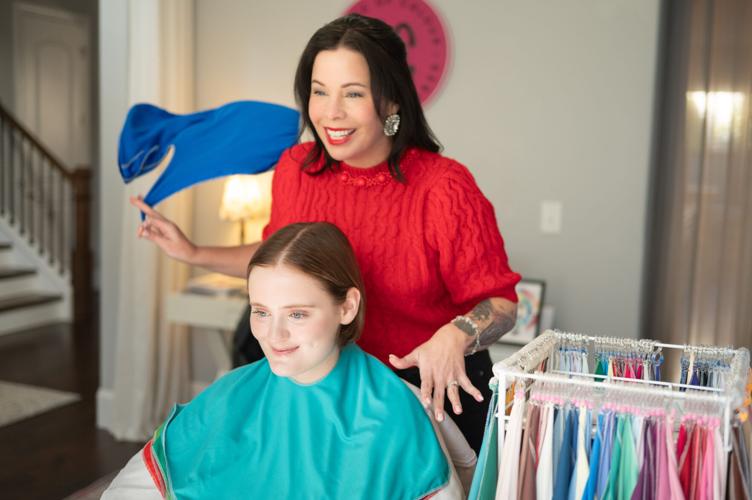
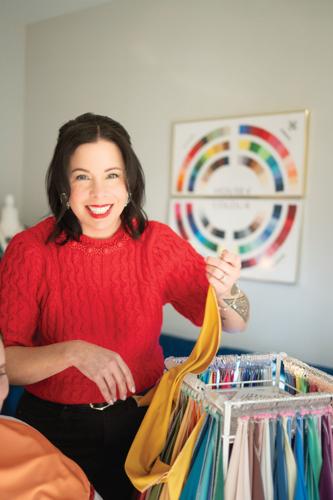
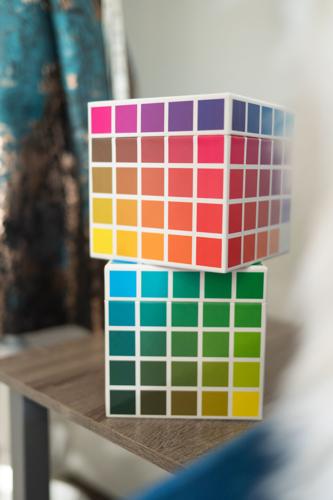
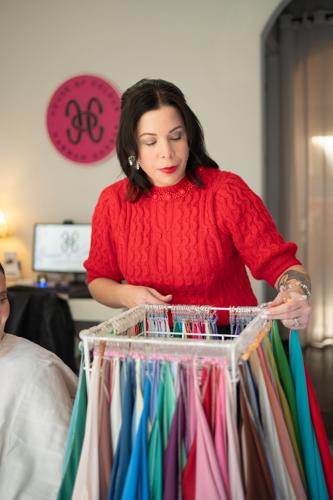

When entering color analyst Hannah Garber’s home studio, a printed wheel of hues, subsectioned by season, catches the eye — along with cool-toned décor to complement her “winter” complexion. Hannah will be the first to tell you color matching isn’t just an online craze. The practice of finding flattering shades is linked to Hollywood, where artist Robert Dorr played with the color groupings Johannes Itten developed during the Bauhaus movement.
Robert noticed how actors went from looking dull to revitalized depending on their clothing. Since 1985, U.K.-based company House of Colour has used this framework, franchising trained stylists around the globe to work from their homes and help clients discover the most vibrant versions of themselves.
Hannah’s motto, “These are tools, not rules,” sums it up: Appointments aren’t meant to change who you are, but instead help you see yourself more clearly. Color theorists look for balance and harmony, and Hannah attests that finding your “wow color” is a transformational experience that can impact how you shop, do your makeup and even dye your hair.

You are a “winter.” How did you discover this about yourself?
Six years ago, I was intrigued because I was having a hard time with my hair color. Every hairdresser I went to always wanted to lighten me, and I really felt like something was off, so color analysis came on my radar. There was no one in the state, so I drove to Louisville, Ky., had my colors done, and 100% knew this had to be in Nashville.
What is training and certification like in your field?
Training was fully [immersive]. It wasn’t an online certificate — I literally flew to Kansas City. That’s where our head trainer was. They bring in actual models, and I work on real bodies. It was very rigorous. In this color think tank, my eye was trained. I feel like I have this superpower now.
For those who’ve never had a color analysis, what can they expect?
In an ideal situation, they would come in with no makeup on. I place them in natural lighting, and then I take them through this series of color comparisons to first find their undertone and then figure out what season they fall into. We do makeup. We giggle. I help them find their best of the best. And it’s not about canceling color. My job is to find the colors that have been waiting for you to find them your whole life.
What impact does color analysis have on people’s confidence, style and how they carry themselves?
I think it’s pretty transformational. Women are so heavily marketed to in the world of vanity, cosmetics, hair products [and] makeup, and we get really lost. There’s a lot of noise, so we spend a lot of time and money experimenting, but always trying to question, “Is this right for me?” This dials everything in. It’s not about trends. It’s not about fast fashion. It’s about, “Is it going to serve me?”

What are the next steps clients should take after their color analyses?
The good news is that they don’t leave the appointment empty-handed. They have resources, like a color fan of swatches, a booklet that explains everything [and] digital resources. The first thing I tell people to focus on in the first two weeks is their cameo — makeup, colors, anything they’re surrounding their face with. Maybe it’s time to revisit their hair color choices with their stylist. I always tell them we’re going to eat this elephant one bite at a time, so we don’t have to go home and burn anything down, but move step by step in a new direction.


Commented
Sorry, there are no recent results for popular commented articles.