


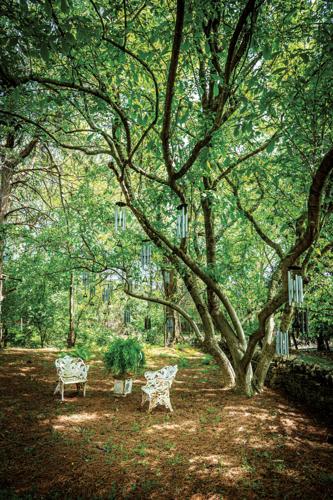



As the sun rises on the horizon, Alix Woody is up to greet the day. She and her “children” — a baker’s dozen of Shih Tzus — stroll the grounds of Wyatt Hall. A gentle breeze often stirs the wind chimes that decorate the saucer magnolia tree standing sentinel in front of the house — a beautiful memorial tribute to precious pups who have come before. Just beyond the tree, and behind a stone wall, sits Wyatt Hall.
The late-Federal-style home — built circa 1800 and named for its mid-20th century owners — sits quietly on Franklin Road, shielded by mature trees. The grounds and garden have been carefully tended by the couple, who have a deep love of the property and who are active with the Heritage Foundation of Williamson County. Inside, much remains the same, like the original poplar wood floors and beautifully patinaed staircase. Two notable changes to the original structure were the 1830s enclosure of the original breezeway to create a formal dining room and, importantly, a number of years later, the addition of indoor plumbing.
“One concept that we feel is important to emphasize is that through all its owners, no one has chosen to alter the original foundational footprint of the house. Wyatt Hall, as it was built, has continued to be respected,” says Benny Woody.

The interior walls of the home have unique stencil patterns which were popular at the time the home was built. In the 1990s a paint conservator for historic museum houses was engaged to explore what original paint colors and painting techniques were hidden under the years of modern paint. The walls, ceilings and woodwork were meticulously scraped to identify original paint colors and even evidence of the stenciling, which were then used to enliven the walls of the home. Alix added more period appropriate stenciling in the foyer and dining room.
The home and grounds are filled with an incredible antique collection. Each vignette is carefully curated and thoughtfully displayed. In many cases, the antiques are useful, like the Scottish laundry rack that is now used for drying flowers. The kitchen houses an AGA cooker, installed in the original cooking fireplace, meaning meals are again prepared where they were in the 1800s. There's even a corner in the foyer featuring some items that belonged to Mrs. Wyatt, who was gifted the house by her husband in 1946 and who named the home Wyatt Hall.

Stepping outside is a wonderful and whimsical adventure. A stunning garden awaits guests with antique benches for resting as well as three log structures. Dotted throughout the grounds are statuary, cast iron garden benches and more. The garden — described as a summer garden — has its own spirit. While some of the ancient boxwoods on the property were greatly harmed in the deep freeze of 2022, there is a sense of renewal as the verdant ferns grace the gardens in early spring. There is a love of the earth as much as a love of the home.
The majority of the Woodys’ preservation efforts have been focused on the gardens and the 19th century Middle Tennessee log structures — a smokehouse and a one-room cabin reconstructed by the Wyatts, and a six-room log house reconstructed by the Woodys. The log cabin and the log house have been restored and offer more living and working space. The octagonal library added at the end of the cabin offers stunning natural light throughout the day and a beautiful view of the garden.

When asked how they believe preserving historic homes contributes to the cultural and architectural heritage of the community, the Woodys answered, “These historic houses and properties are more than just physical structures. They are a part of Franklin’s character and through their preservation, they help give us a sense of connection to this tangible past. Our preserved historic structures are a connection to and a show of respect for our history, our culture and our character as a community.”


Commented
Sorry, there are no recent results for popular commented articles.