


If you went to sleep on the eve of the Case Auctions Winter Fine Art & Antiques sale thinking the carved female figure by William Edmondson was going to trade anywhere near its $40,000 opening bid, you were in for a surprise the next morning. When lot 196 came under the gavel, bidding for the 15.5-inch sculpture quickly broke out of its estimated $80,000 to $90,000 range. In fact, over the course of two breathless minutes — with 36 live bids from the Knoxville auction room, online, and over the phone from across the country — Edmondson’s limestone portrait of a schoolteacher commanded $393,600, including buyer fees.
Held in the auction room of Case’s Knoxville headquarters, the 2026 winter sale consolidated art, silver, jewelry, books, historic firearms, documents, textiles and furniture from more than 200 estates, museums and private and corporate collections, including Vanderbilt University, Memphis Brooks Museum of Art, Chattanooga’s Hunter Museum of American Art and Arkansas Museum of Fine Arts. More than 1,300 lots — many from Nashville — sold live over two days to buyers around the world, with auctioneers Wendell Hanson, Michael DeLisle and David Case coaxing high bids on highlights such as oil paintings by E. Irving Couse and Helen LaFrance, three glass vessels by Dale Chihuly, a Tiffany gold-link bracelet, a 6-carat diamond engagement ring and a Barcelona chair.

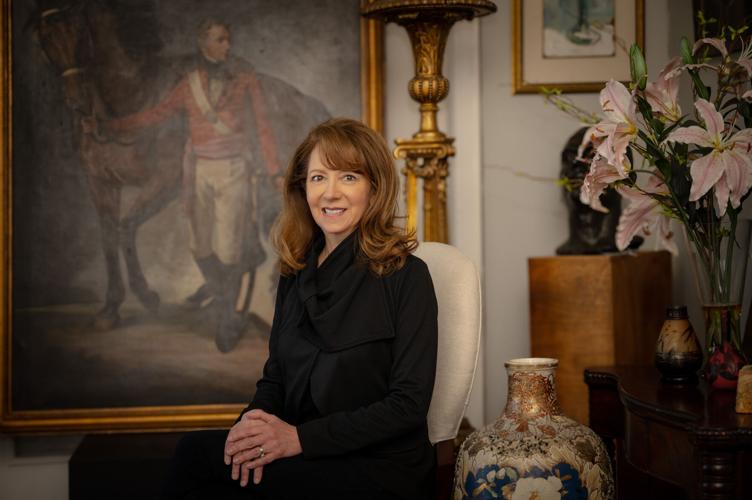
While bidding builds fast and furiously at a live auction, building a sale takes months of research, catalog preparation and relationship management by the Case team, which has consignment offices in Nashville and Chattanooga. “We put incredible emphasis on photography, because we know the majority of our buyers are bidding from afar,” says vice president of fine and decorative arts Sarah Campbell Drury, who leads the Nashville office and has served as an occasional consultant behind the scenes on Antiques Roadshow.
A Lipscomb University graduate, Sarah steered into appraisal and auction work when she inherited a collection of art and antiques from her grandmother. “It made me aware of challenges families face when they become stewards of collections that they can’t absorb all on their own,” she says. After a three-year course of study and national accreditation through the International Society of Appraisers, she hung out her shingle as an appraiser in private practice.
In an early assignment, Sarah appraised the contents of Nashville’s historic Glen Leven estate, through which she met Case co-owners John and Stephanie Case. She joined their firm as the Nashville representative in 2008, at a time when the Tennessee-based auction house was just beginning to leverage the internet to build a global audience. Today, Case auctions engage more bidders from China than from anywhere outside the U.S. and Canada.
In a quiet office on 21st Avenue, Sarah and her colleague John Kindall work with local sellers to evaluate pieces and incorporate them into Case’s semiannual auctions. Valuation can be straightforward, if an owner knows the history of a piece. Or it can require research and investigation by the team, including art historian and museum curator Reilly Shwab, who manages the Knoxville office. The process usually starts with photographs. If an item or collection might be a fit for an international sale, the Case team will schedule a visit at the office or on site.
“Sometimes when we come to a client’s house, we find things they never imagined to be valuable,” Sarah says — like the time she went to evaluate a portrait of Andrew Jackson and happened to recognize an overlooked trinket nearby as a sand sculpture by Andrew Clemens. The sandwork sold at auction for $66,000.
Of course, things can also go the other way. “Many pieces descend in families with a legend attached to them, but the family history attached is actually more of a fairy tale,” she says.


Commented
Sorry, there are no recent results for popular commented articles.