
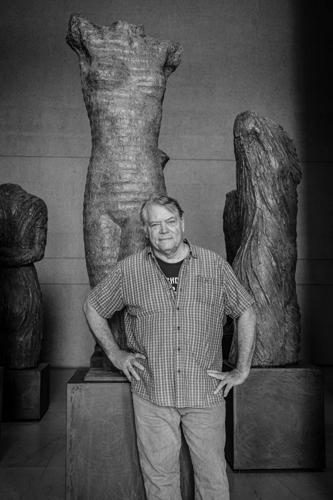


Sculptor Alan LeQuire’s studio has been unusually animated this year. For months, an oversized gymnast made of steel rods, wire lath and gypsum cement arced toward the ceiling, traveling up and down on a chain hoist, as Alan and his team employed an ancient technique of enlarging by contour and cross section to create a graceful human form on a colossal scale.

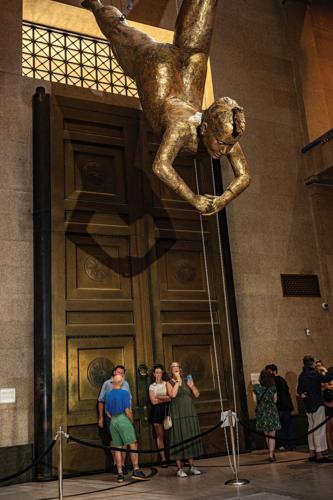
Inspired by Simone Biles, this aerial acrobat silently shared airspace with similarly muscular armatures: a wiry sprinter, evoking fleet-of-foot Tennessee State University alumna Wilma Rudolph, and a swimmer honoring waterborne Olympians Tracy Caulkins and sisters Alex and Gretchen Walsh.
In mid-June, this sculptural trio of “Soaring Olympians” vaulted from the fabrication workshop at LeQuire Gallery on Charlotte Pike to the Parthenon at Centennial Park. The sprinter, swimmer and gymnast now hang in the air, surrounding Alan’s gilded 42-foot sculpture of the goddess Athena, which turns 35 this year.
To celebrate the anniversary of Alan’s iconic “Athena Parthenos” — a replica of Phidias’s fifth-century-B.C. sculpture that once occupied the Parthenon in Athens — Metro Parks and Recreation and Centennial Park Conservancy are hosting an exhibition of new works by Alan, focused primarily on strong women. Monumental Figures, featuring 24 new three-dimensional works, debuted June 13 in the public spaces of Nashville’s Parthenon and outside on park grounds, and will be on display through Sept. 21.

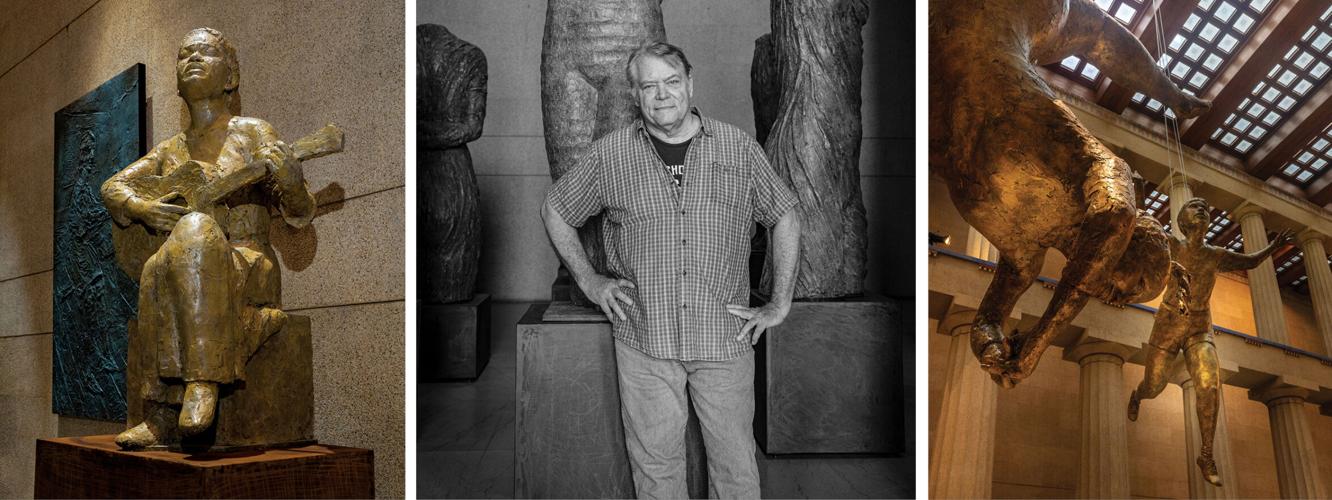
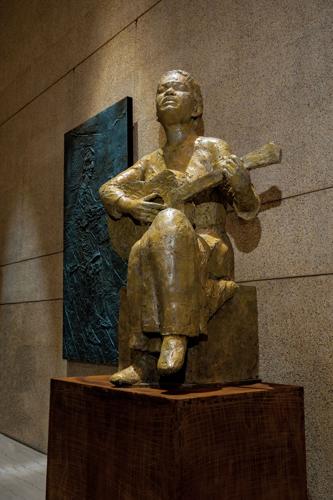
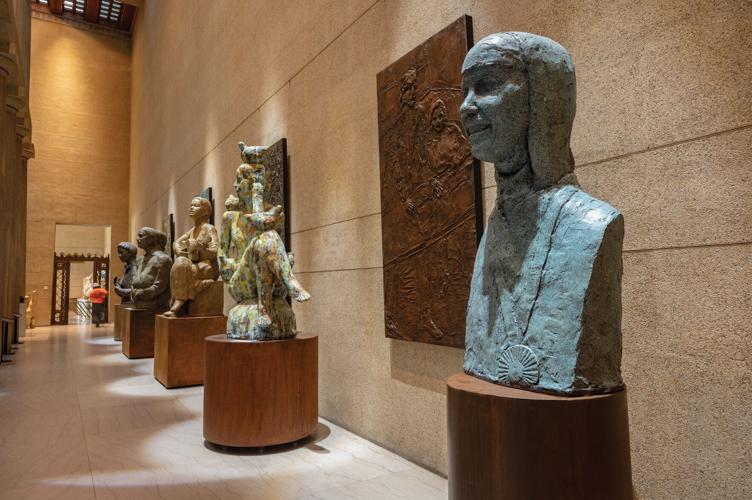
Including the faster-higher-stronger triptych of “Soaring Olympians,” the Monumental Figures exhibition features four main groupings, starting with a colossal portrait of Fannie Lou Hamer at the east doors. When the community organizer and activist delivered testimony at the 1964 Democratic National Convention about her struggle to register to vote as a Black woman, young Alan LeQuire was paying attention. Painted to simulate gilding, Alan’s gleaming homage to the trailblazer sets the tone for another grouping inside the Parthenon’s colonnade, where 10 sculptures flanking Athena honor women whom Alan admires and considers role models. These “Monumental Women” feature:
Dr. Mildred Stahlman, pioneering neonatology researcher at Vanderbilt University Medical Center and longtime family friend, who gave Alan one of his first sculpture commissions.
Dr. Dorothy Brown, Meharry Medical College professor, the first Black female surgeon in the Southeast, and the first Black woman elected to the Tennessee General Assembly.
Sifan Hassan, winner of the marathon at the 2024 Paris Olympic Games.
Diane Nash, legendary civil rights activist.
Odetta, folk and blues singer known as “the voice of the Civil Rights Movement.”
Joan Baez, Rock & Roll Hall of Fame inductee and civil and human rights advocate.

Alongside these cultural heroes, Alan presents four groupings of everyday women, cast in the colossal scale worthy of a Greek deity, to remind viewers of the monumental significance of all people, beyond the headline names of history.
The treasury of the Parthenon features a fourth grouping, “Complete and Unbroken” — a series of 10 larger-than-life human torsos exploring ancient sculpture and the human figure.

In addition to Monumental Figures, the Parthenon is hosting Goddess in Progress, a behind-the-scenes exploration of the development and construction of “Athena Parthenos,” in the East Gallery through April 19, 2026.
“The Parthenon continues to be a valuable example of experimental archaeology, offering both students and scholars the opportunity to experience the art and architecture of ancient Greece firsthand,” says Alan, who was a 26-year-old graduate student when he won the nationwide competition to sculpt the Parthenon’s central icon in his hometown. It took eight years of extensive research, modeling and construction — with ongoing consultation by ancient Greek sculpture specialist Brunilde Sismondo Ridgway — to complete the piece. The unpainted statue was unveiled in 1990. And 12 years later — after significant fundraising — gilding and painting were completed to create the icon as it stands today.
“The project was the completion of my training as a sculptor,” Alan says. “I feel very fortunate to have had this experience with Greek art and the Nashville Parthenon.”


Commented
Sorry, there are no recent results for popular commented articles.